 Fouled Anchor Safety

A job hazard analysis (JHA) breaks one job into its steps, lists the hazards in each step, and records the controls that remove or reduce each hazard before work starts. To write one, choose the job, list its steps, find the hazards, rate the risk, pick controls in hierarchy order, rate what risk remains, and review it with the crew.
The free template below follows that order. It is the same structure JHA Rapid uses, so a JHA drafted in the app and one written by hand line up step for step.
Both files include a blank form and a filled-in example. Free to use and adapt.
1. Choose the job
OSHA's guidance (publication 3071) suggests starting with the jobs most likely to hurt someone: those with the highest injury and illness rates, those that could cause a severe or disabling injury even without a history of incidents, jobs where one simple mistake could cause a severe injury, new jobs or jobs changed by a new process or piece of equipment, and jobs complex enough to need written instructions. Ask the workers too. They know which tasks scare them.
2. Break the job into steps
Watch the job being done and write down what the worker does, in order. Keep it to about ten steps; if you need more, split the job into two JHAs. Start each step with an action verb ("Remove the guard", "Lift the pump onto the cart") and describe what is done, not how to do it safely. That comes later.
3. Identify the hazards in each step
For each step, ask what could go wrong and who could get hurt. Useful prompts: Could the worker be struck by or caught in something? Contact hot, energized or sharp surfaces? Fall? Strain while lifting or twisting? Breathe a dust, vapor or fume? Be exposed to noise, heat or radiation? Write the hazard together with the harm it could cause, such as "respirable silica dust from cutting, leading to silicosis".
4. Rate the risk
Give each hazard a likelihood and a severity from 1 to 5 and multiply them. A 5 × 5 matrix like the one below, which JHA Rapid uses for civilian work, turns the score into a band: 1 to 4 Low, 5 to 9 Medium, 10 to 15 High, 16 to 25 Critical. Military work often uses the MIL-STD-882E matrix instead, and USACE contracts use the E/H/M/L Risk Assessment Code in an Activity Hazard Analysis.
| Likelihood ↓ / Severity → | 1 Negligible | 2 Minor | 3 Moderate | 4 Serious | 5 Catastrophic |
|---|---|---|---|---|---|
| 5 Very likely | 5 | 10 | 15 | 20 | 25 |
| 4 Likely | 4 | 8 | 12 | 16 | 20 |
| 3 Possible | 3 | 6 | 9 | 12 | 15 |
| 2 Unlikely | 2 | 4 | 6 | 8 | 10 |
| 1 Improbable | 1 | 2 | 3 | 4 | 5 |
5. Choose controls in hierarchy order
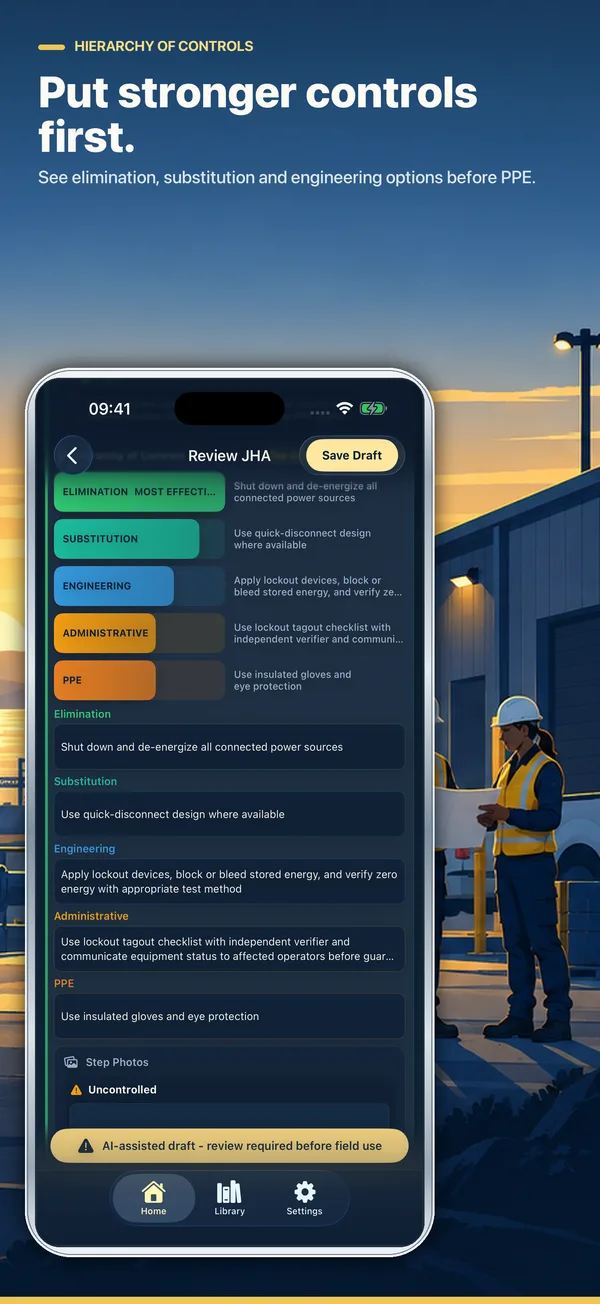
Work down the hierarchy of controls and stop as high as you can. Eliminate the hazard (do the job from the ground instead of a ladder). Substitute something less hazardous (a water-based product instead of a solvent). Engineer it out (guards, local exhaust ventilation, water on a saw blade). Then administrative controls (procedures, training, limiting time, signs and permits). Personal protective equipment comes last because it depends on every worker wearing it correctly every time. Write specific controls: "saw with integrated water delivery" says more than "control dust".
6. Rate the residual risk
Score each hazard again as if the controls are in place. Severity usually stays the same; likelihood drops. If a hazard is still High or Critical, add controls or have a supervisor decide whether the work can go ahead. Showing both ratings documents that the controls reduced the risk, rather than just asserting it.
7. Review it with the crew and keep it current
Walk through the JHA with the people doing the job before they start, and have them sign it. They will catch steps and hazards you missed. Revise it after an injury or near miss, when the equipment or process changes, and whenever the crew finds a better way to do the work.
Example: cutting a concrete slab
This is the filled-in example from the template. Risk is shown as likelihood × severity.
| Step | Hazard | Initial | Controls | Residual |
|---|---|---|---|---|
| 1. Set up the work area and saw | Trips over water hose and cords; lifting the saw | 3 × 2 = 6 | Route hoses away from walkways; mark the area; two-person lift or cart for the saw | 2 × 2 = 4 |
| 2. Cut the slab | Respirable crystalline silica dust | 4 × 4 = 16 | Saw with integrated water delivery (engineering); follow Table 1 of 29 CFR 1926.1153 for the respirator it lists; keep others out of the cloud | 2 × 4 = 8 |
| 2. Cut the slab | Noise from the saw | 4 × 3 = 12 | Hearing protection for the operator and helper; limit cutting time; keep others back | 2 × 3 = 6 |
| 2. Cut the slab | Kickback and blade contact | 3 × 4 = 12 | Guard in place; correct blade for the material; two-hand grip; stand to the side of the cut line | 2 × 4 = 8 |
| 3. Clean up the slurry | Slips; silica when the slurry dries | 3 × 2 = 6 | Wet vacuum or squeegee the slurry; no dry sweeping; clean before it dries | 1 × 2 = 2 |
Silica dust starts as Critical (16) because inhaling it can cause silicosis, an irreversible disease. A saw with water delivery and the respirator listed in Table 1 of the OSHA construction silica standard bring it down to Medium. The severity of 4 does not change; the likelihood does.
Writing a JHA faster
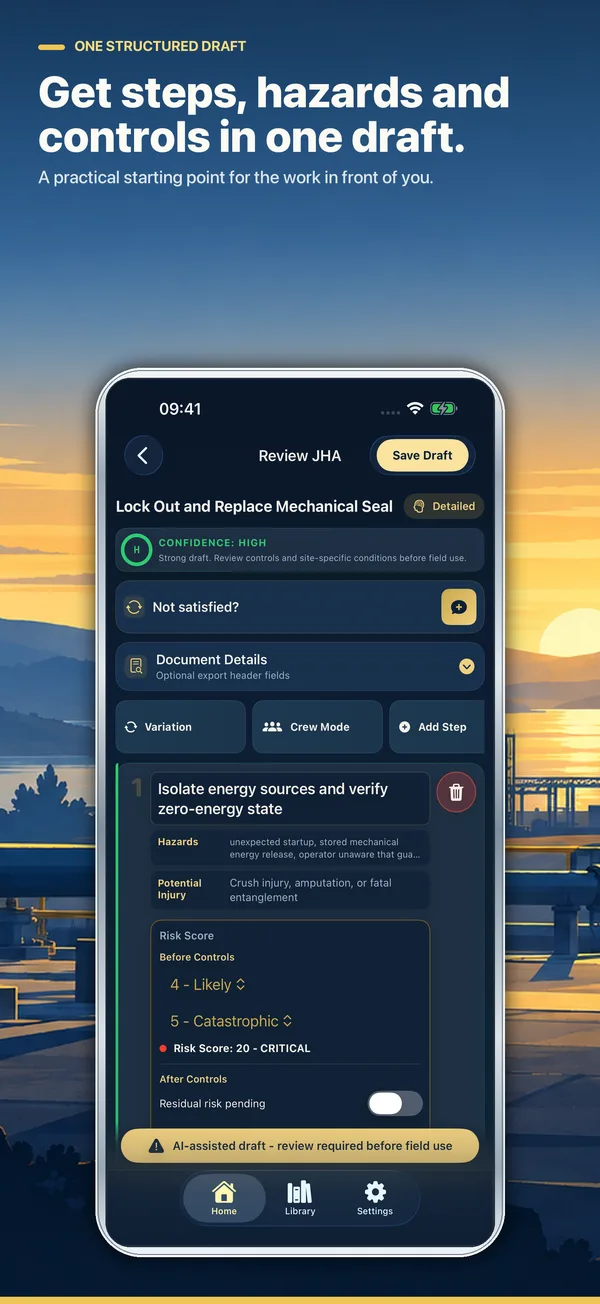
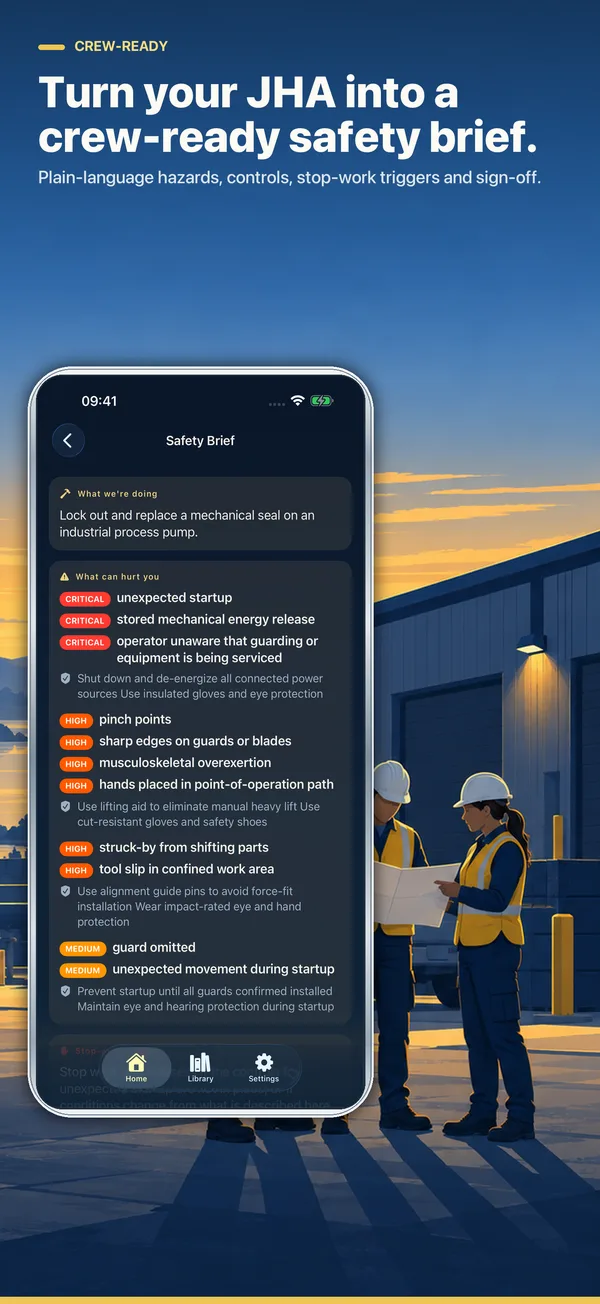
A blank form is fine for one job. For a contractor writing several a week, the slow part is the first draft. JHA Rapid drafts the steps, hazards, potential injuries, controls in hierarchy order and both risk ratings from a short description of the job, then you review and edit every line, add signatures and print it or turn it into a crew safety brief.
Questions
Is a job hazard analysis required by OSHA?
OSHA does not require a JHA for most work, but it recommends them, and some standards require a hazard assessment, such as the PPE hazard assessment in 29 CFR 1910.132(d). Many contracts and company programs also require written JHAs.
What is the difference between a JHA and a JSA?
They are the same document under different names. Job safety analysis (JSA) is common in oil and gas and construction; job hazard analysis is the term OSHA uses.
How often should a JHA be reviewed?
Before each use with the crew, and whenever the job, equipment or conditions change or an incident or near miss happens on that job.