 Fouled Anchor safety
Light Level Measurement
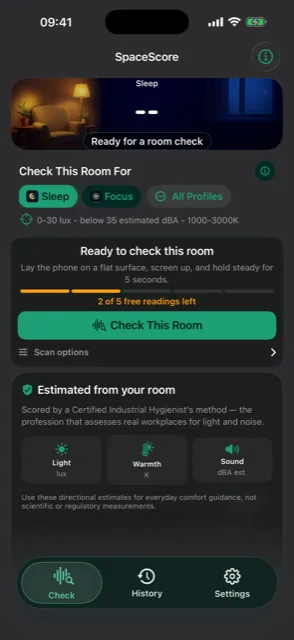
Uses the camera’s exposure and image brightness to estimate room light in lux in real time, then compares that estimate to your selected profile. A directional read for choosing a room — not a calibrated photometer.
Measure • Score • Optimize • Work Better
Real-time environmental scoring for workspaces. Instantly measure and rate lighting, noise, and color temperature — build custom profiles and passively monitor your environment throughout the day.
All fourteen SpaceScore profiles with the light and noise targets the app uses.
Uses the camera’s exposure and image brightness to estimate room light in lux in real time, then compares that estimate to your selected profile. A directional read for choosing a room — not a calibrated photometer.
Derives color temperature in Kelvin from camera white balance, so you can tell cool alert-promoting light from warm relaxing light. Best treated as directional guidance rather than a spectrometer reading.
Measures ambient decibel levels via your device microphone. Quantify background noise in offices, coffee shops, libraries, or any workspace you're evaluating.
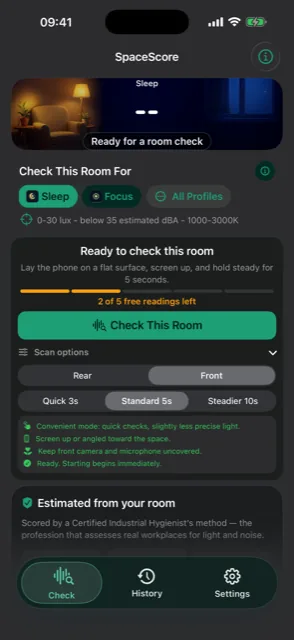
Light, color temperature, and noise combine into a single SpaceScore telling you whether the room meets the targets for what you are about to do.
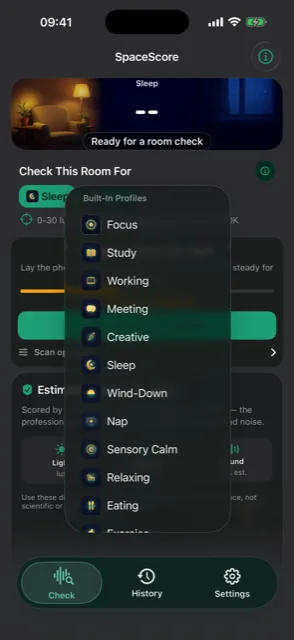
Create named profiles with your own light and noise targets, or start from the fourteen built in — Focus, Working, Study, Meeting, Creative, Sleep, Wind-Down, Nap, Sensory Calm, Relaxing, Eating, Exercise, Reading, and Morning.
Enable background monitoring to log environmental conditions over time. Identify patterns, track how conditions shift throughout the day, and get notified when targets are met.
Review historical scan data to understand how environments perform over time. Export records for documentation or wellness tracking purposes.
300–600 lux · ≤50 dB
Balanced conditions for reading, writing, or concentrated work.
400–750 lux · ≤45 dB
Brighter light for extended reading; quiet enough to retain information.
300–700 lux · ≤55 dB
General desk work - comfortable for longer sessions at a screen.
400–750 lux · ≤60 dB
Brighter, livelier conditions suited for conversations and calls.
150–450 lux · ≤50 dB
Softer light and moderate quiet for creative thinking and open-ended work.
0–30 lux · ≤35 dB
Near-dark and very quiet for pre-sleep and sleeping spaces.
30–150 lux · ≤40 dB
Dim and quiet to help your body prepare for sleep.
0–50 lux · ≤38 dB
Short-rest conditions - darker and quieter than typical daytime.
150–350 lux · ≤40 dB
Lower light and quieter noise for environments where less stimulation is preferred.
100–300 lux · ≤50 dB
Comfortable ambient conditions for unwinding without falling asleep.
150–400 lux · ≤65 dB
Comfortable dining conditions - moderate light, relaxed noise.
300–1000 lux · ≤75 dB
Brighter, higher-energy conditions for workouts and active movement.
500–800 lux · ≤45 dB
Well-lit and quiet for comfortable extended reading.
500–1000 lux · ≤60 dB
Bright, alert conditions to help you wake up and start the day.
Free to download on iPhone and iPad. Veteran and military pricing is available in-app.