 Fouled Anchor Safety

An Activity Hazard Analysis (AHA) is the job hazard analysis that EM 385-1-1, the US Army Corps of Engineers safety manual, requires contractors to prepare for each definable feature of work before that work starts. Like a JHA it lists steps, hazards and controls, but it also rates each step with a Risk Assessment Code (E, H, M or L) and records the equipment, inspections, training and competent or qualified persons the work needs.
Which edition applies
The current edition of EM 385-1-1 is dated 15 March 2024. It replaced the 30 November 2014 edition and renamed the manual "Safety and Occupational Health Requirements". Your contract says which edition governs, so check it before you build an AHA from an old template. Many NAVFAC and other federal construction contracts also invoke EM 385-1-1.
What an AHA includes
- The definable feature of work and the contract number.
- The work broken into steps, with the hazards of each step and the controls for each hazard.
- A Risk Assessment Code (RAC) for each step, and an overall RAC for the activity.
- Equipment to be used.
- Inspection requirements for that equipment and the work.
- Training requirements, including any certifications.
- Competent persons and qualified persons, by name.
- Contractor and government review.
Government review of an AHA does not make the government responsible for the contractor's risk. The contractor still owns the hazards and the controls.
The E/H/M/L risk matrix
Each step is rated for probability (Frequent, Likely, Occasional, Seldom, Unlikely) and severity (Catastrophic, Critical, Marginal, Negligible). Where they meet on the matrix is the RAC: E for extremely high, H for high, M for medium, L for low. This is the matrix JHA Rapid applies to AHAs.
| Probability ↓ / Severity → | Catastrophic | Critical | Marginal | Negligible |
|---|---|---|---|---|
| Frequent | E | E | H | M |
| Likely | E | H | M | L |
| Occasional | H | H | M | L |
| Seldom | H | M | L | L |
| Unlikely | M | L | L | L |
Most contracting offices expect the overall RAC at the top of the AHA to be the highest RAC of any step. A step that stays at E or H after controls needs attention before work starts, often a higher level of review.
AHA vs OSHA JHA
| OSHA job hazard analysis | USACE activity hazard analysis | |
|---|---|---|
| Required by | Recommended by OSHA; required by many employers and contracts | Required by EM 385-1-1 on contracts that invoke it |
| Scope | One job or task | One definable feature of work |
| Risk rating | Often a 5 × 5 likelihood × severity score (Low to Critical) | Probability × severity Risk Assessment Code (E, H, M, L) |
| Extra fields | Usually none | Equipment, inspections, training, competent and qualified persons |
| Review | Supervisor and crew | Contractor and government review before work starts |
Converting a JHA into an AHA
The steps, hazards and controls carry straight over. What changes is the rating and the added fields. Re-rate each step on the probability × severity matrix rather than copying the old score, because the scales differ: a 5 × 5 Critical does not map one-to-one onto E. Then fill in the equipment, inspections, training and named competent and qualified persons, and get it reviewed before the work begins.
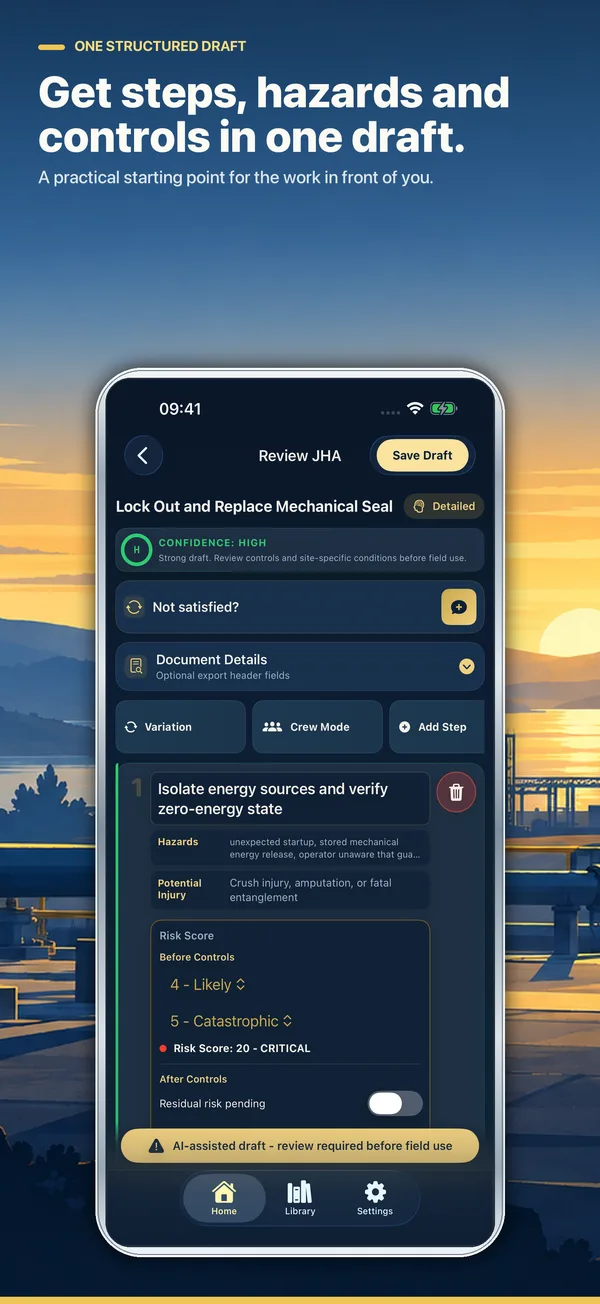
In JHA Rapid, switching a JHA to the USACE AHA format re-maps the ratings onto the E/H/M/L matrix, marks every step for review and clears earlier approvals, so nothing goes out under the old framework by accident. It prints in a landscape AHA layout.

Questions
Do I need an AHA for every task on a USACE job?
EM 385-1-1 calls for an AHA for each definable feature of work, which is usually a phase of construction such as excavation, concrete placement or roofing, not every individual task. Your contract and the government safety office decide how features of work are divided.
Can I use an OSHA JHA instead of an AHA on a USACE contract?
Not as is. A contract that invokes EM 385-1-1 expects the AHA content: the E/H/M/L Risk Assessment Codes, equipment, inspections, training and named competent and qualified persons.